
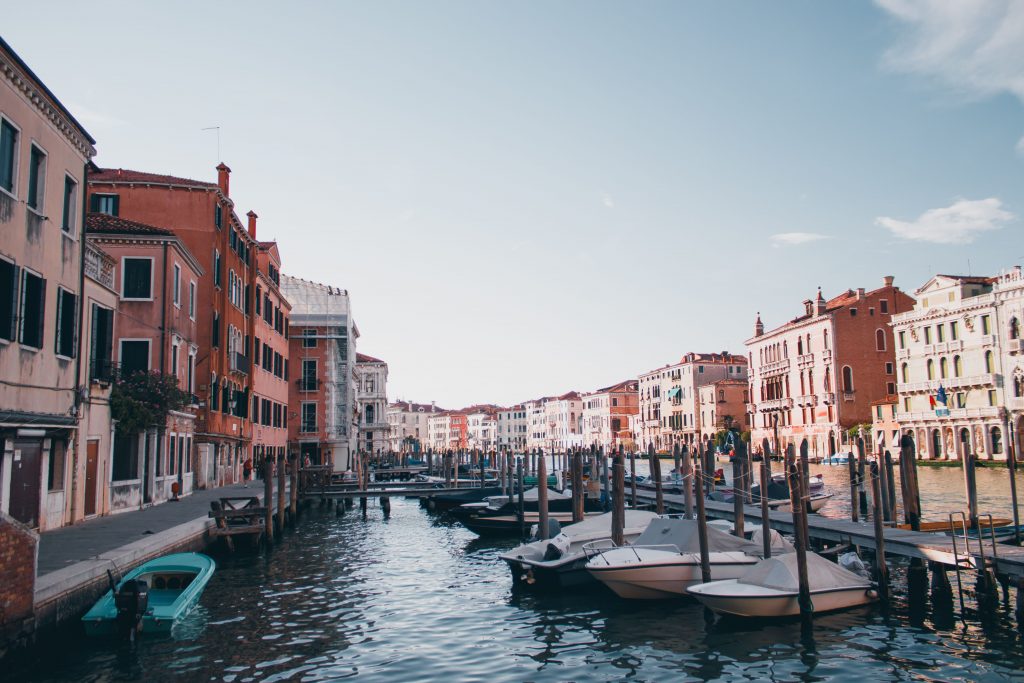
Picture this: you step out of the train station, and instead of a parking lot or a taxi line, there’s the Grand Canal. Water buses glide past 500-year-old palaces. Church bells ring somewhere across the water. Nobody honks, because there are no cars.
That’s your first five minutes in Venice. If you’ve never left the United States, it’s hard to imagine a better way to start.
Why Venice makes a perfect first trip abroad
Venice is one of the few places on Earth that looks exactly like the postcards. It also happens to be one of the easiest foreign cities for a nervous first-timer.
- It’s small and walkable. The historic center fits on islands you can cross on foot in about an hour. You can’t get truly lost, only pleasantly lost.
- No cars, no driving stress. Forget renting a car or decoding foreign road signs. You walk, or you ride the water bus (vaporetto).
- English is widely spoken. Hotels, restaurants and shops in Venice are used to American visitors. A few words of Italian earn smiles, but you won’t be stranded without them.
- It feels safe. Venice has very little violent crime. The main thing to watch is your wallet in crowds, just like any busy tourist spot.
- It’s a gateway to the rest of Italy. Fast trains connect Venice to Florence, Milan and Rome, so one trip can easily become two or three cities.
Most of all, Venice delivers the feeling you’re traveling for: that you are somewhere truly different from home.
Experiences you’ll remember forever
These are the moments that turn a first trip into a lifelong travel habit.
- Ride the Grand Canal on Vaporetto Line 1. It’s the cheapest sightseeing cruise in the world. Grab a seat at the front and watch palaces, markets and bridges roll by.
- Stand in St. Mark’s Square at dawn. By 7 a.m. the crowds haven’t arrived, and you’ll have the golden domes of St. Mark’s Basilica almost to yourself.
- Tour the Doge’s Palace. Walk through the halls where Venice ruled a maritime empire, then cross the Bridge of Sighs from the inside, as prisoners once did.
- Take a gondola ride. Yes, it’s a splurge, and yes, it’s worth it once. Share it with up to five people to split the cost, and ride through quiet side canals rather than the busy main routes.
- Eat like a Venetian. Skip the big menus with photos. Hop between small wine bars called bacari for cicchetti (Venetian tapas) and a spritz, standing at the counter with the locals.
- Watch glass being blown on Murano. A short boat ride takes you to the island that has made glass for centuries.
- Get colorful on Burano. This fishing village is famous for houses painted every shade of the rainbow. Bring your camera and an appetite for seafood risotto.
- Get lost on purpose. Put your phone away for an afternoon. Wander the Cannaregio or Castello neighborhoods, where laundry hangs over canals and kids play soccer in tiny squares.
Make it a grand tour: easy add-ons from Venice
Italy’s high-speed trains make it simple to build a 10-day dream trip with Venice as your starting point. Times below are approximate for fast trains.
| Destination | Travel time from Venice | Why go |
|---|---|---|
| Verona | About 1 hour 15 min by train | Romeo and Juliet’s city, a Roman arena and a relaxed small-town feel |
| Florence | About 2 hours by train | Michelangelo’s David, the Duomo and Tuscan food and wine |
| Milan | About 2.5 hours by train | Fashion, The Last Supper and a jumping-off point for Lake Como |
| Lake Como | About 3.5 hours (train via Milan) | Lakeside villas, mountain views and boat hops between villages |
| Rome | About 4 hours by train | The Colosseum, the Vatican and 2,000 years of history |
| The Dolomites | About 2.5–3 hours by bus or car | Dramatic jagged peaks, hiking in summer and skiing in winter |
A classic first-timer route: 3 nights in Venice, 3 in Florence, 4 in Rome, then fly home from Rome. Book an open-jaw (“multi-city”) ticket so you don’t have to backtrack.
The practical part: it’s easier than you think
The paperwork for a first trip to Italy is short. Here’s what Americans need to know right now.
Passport. It’s the only document you need to enter Italy as a tourist; no visa is required for stays up to 90 days. Your passport should be valid for at least three months after you plan to leave Europe. If you don’t have one yet, apply several months ahead.
New digital border check (EES). Europe’s Entry/Exit System has replaced passport stamps. On your first arrival, expect to scan your fingerprints and have your photo taken at the border. Allow a little extra time at passport control.
ETIAS isn’t required yet. Europe’s online travel authorization has been delayed again and is now expected in 2027, with a fee of €20. Until the EU announces a firm start date, don’t pay any website offering to “pre-register” you.
Venice’s day-tripper fee. On busy peak days, Venice charges visitors who don’t stay overnight an access fee. In 2026 it ran on 60 days between April 3 and July 26, at €5 if booked more than four days ahead and €10 closer in. Overnight guests don’t pay it but still register for a free QR code. Venice is weighing a higher fee and longer season for 2027, so check the official Venezia Unica portal before you go. The easy fix: sleep in Venice at least one night. You’ll see the city at its most magical anyway.
Getting there. Venice’s Marco Polo Airport (VCE) has nonstop flights from several US hubs in season, and many more one-stop options. From the airport, take the Alilaguna water bus or a water taxi straight into the city.
Money. Italy uses the euro. Credit cards and tap-to-pay work almost everywhere, but carry some cash for small cafes and tips. Tell your bank you’re traveling, and use a card with no foreign transaction fees.
Phone. Ask your carrier about an international plan, or buy an eSIM before you leave for cheap data.
When to go. For the best balance of weather and crowds, aim for April–May or September–October. Summer is hot and packed. November through February is quiet and atmospheric, but bring rain boots: autumn and winter bring acqua alta, high tides that can briefly flood low-lying squares.
Insider tips for first-timers
- Pack light. Venice has hundreds of bridges, most with steps. A small rolling bag or backpack beats a giant suitcase every time.
- Stay in the historic center. Hotels on the mainland in Mestre are cheaper, but waking up in Venice itself is the whole point.
- Buy a multi-day vaporetto pass. Single water-bus rides add up fast. A pass lets you hop on and off freely, including to Murano and Burano.
- Explore early and late. Day-trippers and cruise crowds peak midday. Venice belongs to you before 9 a.m. and after 6 p.m.
- Walk away from the crowds to eat. Restaurants right on St. Mark’s Square or the Rialto Bridge charge premium prices. Two streets back, food gets better and cheaper.
- Know the dining customs. A small coperto (cover charge) on the bill is normal. Tipping isn’t expected like in the US; rounding up or leaving a few euros for great service is plenty.
- Respect the city. Sitting on monuments, swimming in canals and picnicking in St. Mark’s Square can get you fined. Keep to the right on narrow streets and step aside on bridges to take photos.
- Learn five words. Buongiorno (good morning), grazie (thank you), per favore (please), scusi (excuse me) and il conto (the check) go a long way.
- Get travel insurance. For a first big trip abroad, coverage for cancellations, lost bags and medical care buys real peace of mind.
Your adventure starts with one booking
Every seasoned traveler had a first trip. Theirs started the same way yours will: with a passport application, a flight search and a little nerve.
Venice rewards that nerve generously. You’ll drink espresso standing at a marble counter, hear your footsteps echo down an empty alley at night, and watch the sun set gold over the lagoon from a water bus. Then you’ll come home already planning trip number two.
So check your passport, pick your season and start looking at flights. La Serenissima, “the Most Serene” city, is waiting.
